
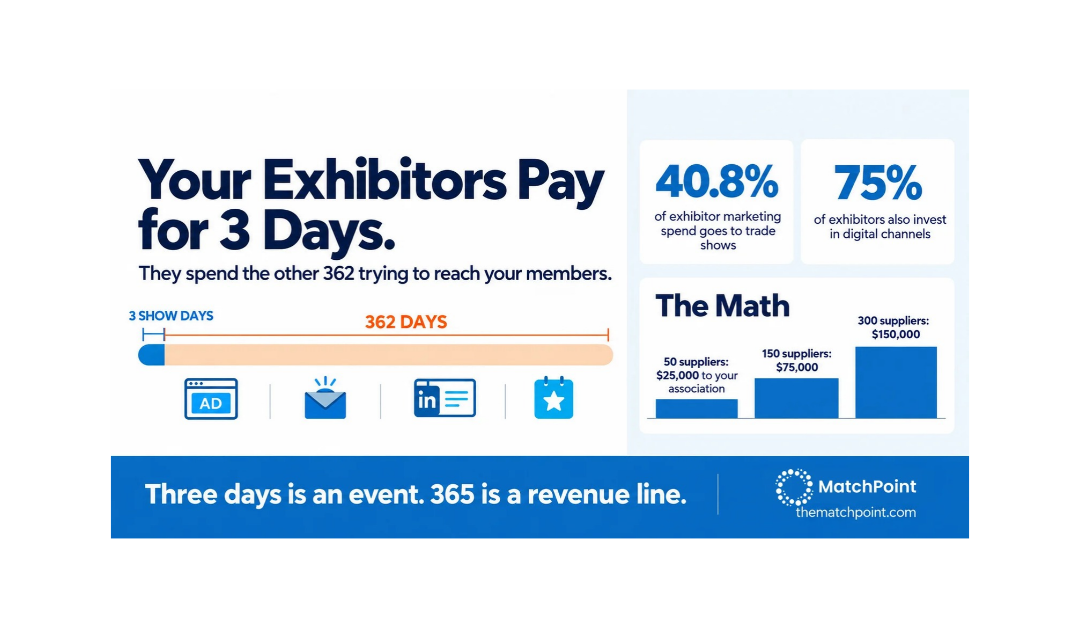
Your exhibitors pay you for three days.
Then they spend the other 362 trying to reach your members somewhere else. Paid ads. Cold email. LinkedIn. Other people’s events.
That money is already being spent on your audience. You’re just not the one collecting it.
This guide shows how associations earn non-dues revenue from exhibitors all year, not just during the annual meeting. You’ll get five proven models, the math, a 90-day launch plan, and the mistakes that kill member trust.
I ran shows for 20 years before I moved into event tech. The pattern never changed: we treated exhibitors like a once-a-year transaction. They treated us the same way.
That’s the gap.
Key Takeaways
- Exhibitors are your most underused non-dues revenue source. Most associations only sell them access during the show.
- The budget already exists. Trade shows make up 40.8% of exhibitor marketing spend, and 75% of exhibitors also invest in digital channels alongside their shows (CEIR 2026 Marketing Spend Decision Report).
- Year-round access is the product. A supplier marketplace, smart introductions, and digital sponsorships turn one invoice into recurring revenue.
- Member value comes first. Every model below only works if members want the connection. Opt-in beats opt-out every time.
- You can launch in 90 days without adding staff if the platform handles matching, billing, and reporting.
What Is Non-Dues Revenue?
Non-dues revenue is any income an association earns outside of membership dues. Common sources include conferences, trade show booth sales, sponsorships, education and certification, advertising, and affinity programs.
It matters more every year.
Non-dues revenue has been the top financial challenge for associations three years running, according to Naylor’s 2024 Association Benchmarking Report (via ASAE). And in MGI’s 2025 study, only 45% of respondents reported membership growth over the previous year (MGI 2025 Membership Marketing Benchmarking Report).
Dues alone can’t carry the budget. Everyone knows that.
The real question is where the next dollar comes from.
Why Exhibitors Are Your Most Underused Revenue Source
Most associations look for new revenue in new places. New courses. New events. New sponsors.
Meanwhile, the best prospects are already on the floor plan.
Think about who your exhibitors are:
- The supplier who renews every year but quietly asks if the show is still worth it
- The startup that bought a 10×10 because it can’t afford to reach your members any other way
- The category leader with a big booth and an even bigger budget that goes everywhere except to you after the show ends
All three want the same thing: qualified conversations with your members.
You own the one thing they can’t buy anywhere else. Trusted access to a defined community.
Most associations sell that access for three days. Then they give it away for free, or not at all, for the rest of the year.
The 362-Day Gap
Here’s how exhibitor spend usually flows.
| During the show (3 days) | After the show (362 days) | |
|---|---|---|
| Where exhibitor budget goes | Your booth, sponsorship, and registration fees | Ads, email lists, other events, sales reps |
| Who earns the revenue | The association | Everyone except the association |
| Member experience | Organized, relevant, trusted | Random cold outreach |
| Data the association keeps | Badge scans and attendance | Nothing |
Exhibitors don’t stop selling when the show closes. They just stop paying you.
Quick test: what’s the last dollar an exhibitor paid your association between events?
If you can’t answer that, you’ve found your next revenue line.
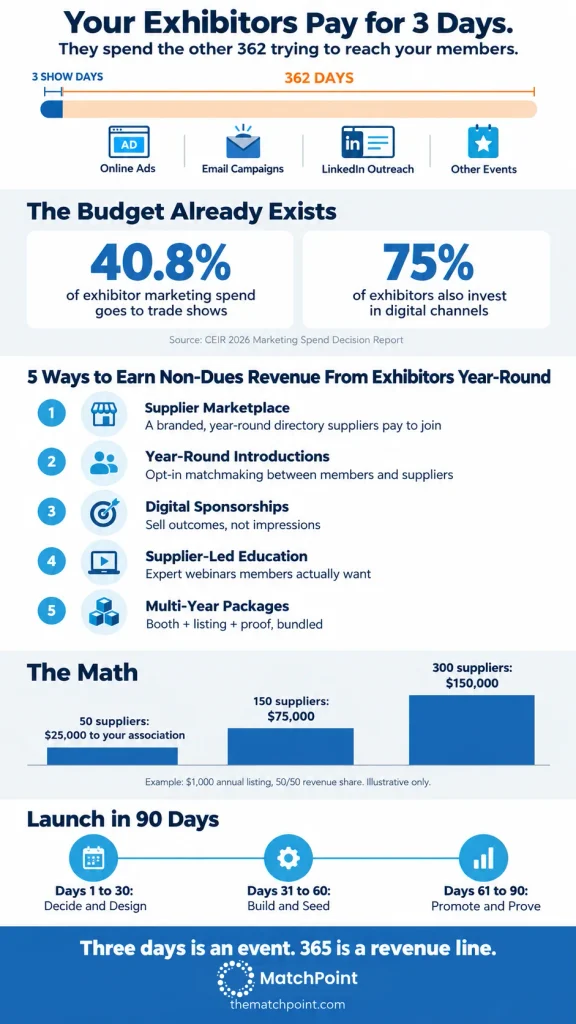
The 362-Day Exhibitor Revenue Gap: where exhibitor budgets go, five ways to capture them, the math, and a 90-day launch plan.
5 Ways Associations Earn Non-Dues Revenue From Exhibitors Year-Round
1. Launch an Association Supplier Marketplace
An association supplier marketplace is a year-round, member-facing directory where vetted suppliers pay for a listing. Members search for solutions. Suppliers get found by the right buyers.
This is the highest-leverage model because it turns every exhibitor into a recurring subscription.
What makes it work:
- An annual listing fee that auto-renews
- Your brand on it, not a vendor’s (white-label)
- Smart matching that puts suppliers in front of members with a real need, not just an alphabetical list
- Activity reports so suppliers see exactly what they got for their money
A static directory is not a marketplace. A PDF buyer’s guide is not a marketplace. If suppliers can’t see results, they won’t renew.
2. Sell Year-Round Matchmaking and Introductions
At the show, AI matchmaking helps attendees and exhibitors find each other. (New to this? Read our guide on what AI event matchmaking is.)
The same engine can keep working after the show closes.
Members who opt in can receive relevant supplier suggestions all year. Exhibitors pay for a place in that flow. The association controls the rules, the volume, and the quality.
This is the difference between a lead list and a warm introduction.
One gets ignored. The other gets a meeting.
3. Offer Digital Sponsorships Tied to Real Engagement
Logo placements are easy to sell once. They’re hard to renew.
Digital sponsorships that tie to engagement renew better because the sponsor sees proof. Options include:
- Sponsored categories inside your supplier marketplace
- Featured placement in member newsletters, tied to a specific topic
- Sponsored pre-event outreach that helps suppliers book meetings before the doors open (we covered this in how event matchmaking improves sponsor engagement before an event)
Sell outcomes, not impressions.
4. Package Supplier-Led Education
Your members want to learn. Your exhibitors are experts in their category.
Put them together with guardrails:
- Quarterly supplier webinars on a member-voted topic
- Case study sessions reviewed by your education team
- “Ask the expert” office hours inside the marketplace
Charge suppliers to present. Keep it educational, not a sales pitch. Your members will tell you fast if you get it wrong.
5. Build Data-Backed, Multi-Year Exhibitor Packages
Once you track year-round engagement, you can sell something most associations can’t: proof.
Bundle the booth, the marketplace listing, and digital sponsorship into one annual package. Show the supplier how many members viewed, saved, and contacted them. Then offer a multi-year rate.
This protects your show revenue, too. Exhibitors who get value all year are far less likely to cut their booth when budgets tighten. (More on that in how attendee engagement drives stronger exhibitor ROI.)
Retention is revenue.
The Math: What a Supplier Marketplace Can Earn
Here’s a simple example using a $1,000 annual listing and a 50/50 revenue share between the association and the platform. These are illustrative numbers, not a guarantee. Your results depend on your exhibitor count, pricing, and how you promote it.
| Suppliers listed | Gross annual revenue | Association share (50%) |
|---|---|---|
| 50 | $50,000 | $25,000 |
| 150 | $150,000 | $75,000 |
| 300 | $300,000 | $150,000 |
Three things jump out.
It recurs. Listings auto-renew. You aren’t rebuilding the number from zero every year.
It scales with your exhibitor base. Your current exhibitors are the first buyers. Suppliers who never exhibited become the second wave.
It costs you almost nothing to deliver. With a revenue-share model, the platform carries the build, the billing, and the support.
Compare that to launching a new conference.
How to Launch a Year-Round Exhibitor Program in 90 Days
Days 1 to 30: Decide and Design
- Pick your model. Start with the supplier marketplace. The other four build on it.
- Set your pricing and your rules. Who qualifies? What categories? How often can suppliers reach members?
- Get board and staff buy-in by showing the revenue math and the member-value case side by side.
Days 31 to 60: Build and Seed
- Launch under your brand.
- Invite your current exhibitors first. They already trust you.
- Seed each category with enough suppliers that members find real options on day one.
Days 61 to 90: Promote and Prove
- Announce it to members as a benefit, not an ad channel.
- Promote it at your next event so the show and the marketplace feed each other.
- Send suppliers their first activity report. This is what drives renewals.
Mistakes That Kill Year-Round Exhibitor Revenue
Selling access you haven’t earned. If members didn’t opt in, don’t sell their attention. You’ll trade short-term revenue for long-term trust.
Launching a directory and calling it a marketplace. Static lists don’t show results. No results, no renewals.
Pricing like a booth. Year-round listings should be simple and affordable enough that a small supplier says yes without a committee.
Skipping the report. Suppliers renew what they can measure. Send proof every quarter.
Treating it as a side project. If nobody owns it, it fades. Give one staff member clear ownership, even part time.
How to Measure Success
Track these five numbers every quarter:
- Supplier renewal rate. The single best sign the program works.
- Member engagement. Searches, profile views, saves, and contact requests.
- Introductions made. How many member and supplier connections happened.
- Revenue per exhibitor. Total annual revenue from each exhibitor across the show and year-round products.
- Show retention. Are exhibitors in the program more likely to rebook their booth?
If renewal rate and show retention both climb, you’ve built something that compounds.
Frequently Asked Questions
What is non-dues revenue for associations?
Non-dues revenue is any income an association earns outside of membership dues. It includes conference registration, trade show booth sales, sponsorships, education, certification, advertising, and supplier programs. Associations rely on it to fund member services when dues growth slows.
How can associations earn revenue from exhibitors outside the annual meeting?
The most effective way is a year-round supplier marketplace where exhibitors pay an annual fee to be found by members. Other options include opt-in matchmaking and introductions, digital sponsorships tied to engagement, supplier-led education, and multi-year exhibitor packages that bundle the booth with year-round visibility.
What is an association supplier marketplace?
An association supplier marketplace is a branded, year-round directory where vetted suppliers pay to list their products and services for members. Unlike a static buyer’s guide, a true marketplace uses matching to connect members with relevant suppliers and gives suppliers reports showing views, saves, and contacts.
How much should an association charge for a supplier listing?
Pricing depends on your audience size and industry, but year-round listings are usually priced well below a booth so small suppliers can say yes quickly. Many programs use a flat annual fee that auto-renews, which keeps the decision simple and the revenue predictable.
Will a supplier marketplace annoy our members?
Not if members stay in control. Use opt-in matching, limit how often suppliers can reach out, and only list vetted suppliers. When members find solutions they actually need, the marketplace becomes a member benefit instead of an ad channel.
Does year-round exhibitor revenue hurt booth sales at the show?
It usually helps. Exhibitors who get value all year have more reasons to keep their booth, and the marketplace gives you engagement data to justify renewals. Bundling the booth with a year-round listing also makes it harder for exhibitors to cut the show when budgets tighten.
How long does it take to launch a year-round exhibitor program?
With the right platform, most associations can launch in about 90 days: 30 days to set pricing and rules, 30 days to build and invite current exhibitors, and 30 days to promote it to members and send the first supplier reports.
Do we need extra staff to run it?
Not necessarily. With a revenue-share platform, the vendor typically handles the technology, billing, matching, and reporting. Your team owns the rules, the member relationship, and promotion. One staff owner, even part time, is usually enough.
Turn Your Exhibitors Into a Year-Round Revenue Line
Your exhibitors already want your members.
Your members already need their solutions.
The only question is whether you connect them for three days, or for all 365.
MatchPoint helps associations launch a white-label supplier marketplace with AI matchmaking, year-round introductions, and reporting that drives renewals, on a revenue-share model with no upfront build cost.
See how MatchPoint works for associations or talk with our team.
Three days is an event. 365 is a revenue line.